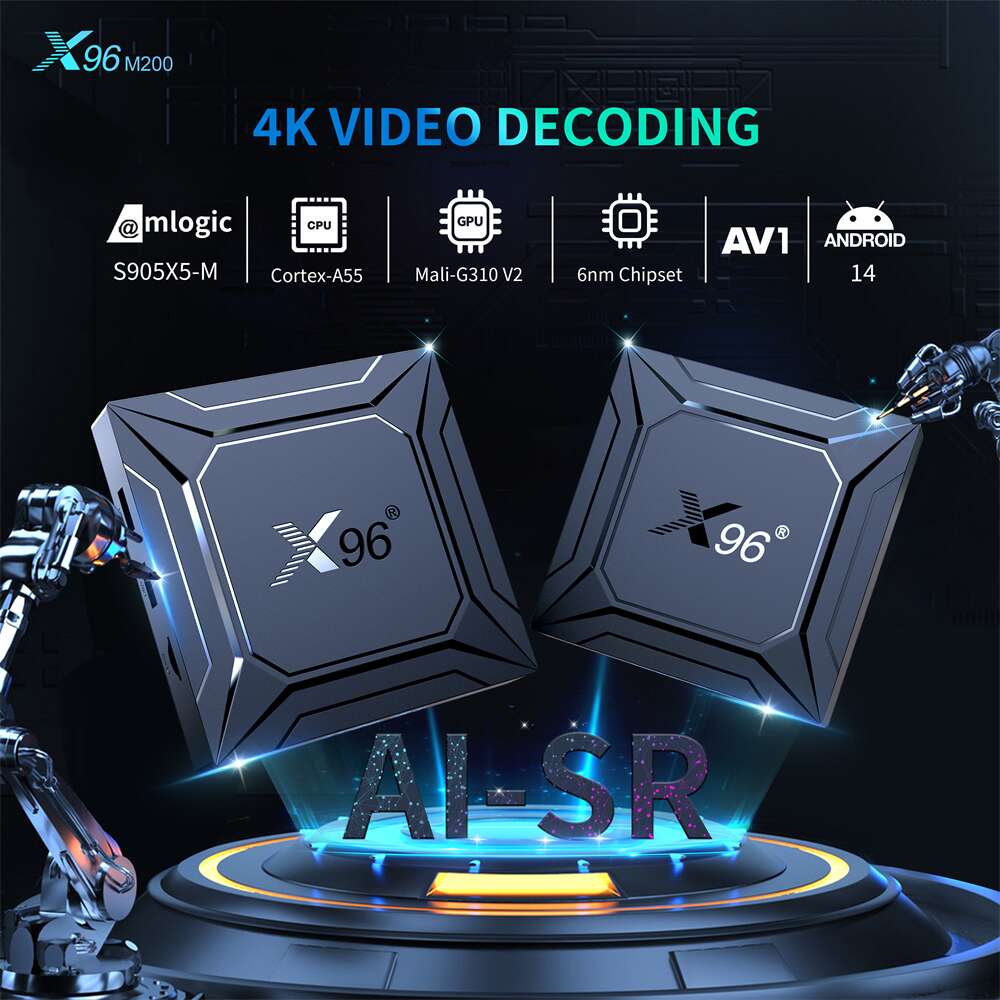
6nm Efficiency & AI Super Resolution: Amlogic S905X5M vs. S905X4
The home entertainment ecosystem is undergoing a quiet revolution driven by silicon architecture enhancements. For years, the mid-range streaming device segment was dominated by system-on-chips built on mature 12nm process nodes. Among these, the Amlogic S905X4 emerged as a foundational workhorse, powering millions of Android TV boxes, operator set-top boxes, and standalone media players across the globe. However, as 4K streaming platforms push higher bitrates, advanced codecs, and richer user interfaces, the thermal and processing limits of older manufacturing nodes have become apparent.
Enter the latest silicon generation. This comparison between Amlogic S905X5M and S905X4 represents a major turning point in how budget and mid-tier media platforms balance thermal envelopes, graphical output, and image post-processing. Moving from a 12nm node down to an advanced 6nm process brings tangible advantages in dynamic power draw and sustained performance. Simultaneously, integrating dedicated neural processing blocks shifts the burden of video scaling from raw compute to machine learning algorithms. In this detailed comparative analysis, we examine the architectural shifts, video processing engines, GPU performance profiles, and real-world deployment metrics that separate these two popular streaming SoCs.
1. Microarchitecture and Manufacturing Process Advances
To understand the practical differences between these two silicon designs, one must first look at the underlying fabrication technology and CPU cluster configurations. The older S905X4 relies on a 12nm FinFET manufacturing process, housing a quad-core ARM Cortex-A55 cluster clocked at up to 2.0 GHz. While the Cortex-A55 architecture remains remarkably efficient for lightweight tasks, operating on a 12nm node means that sustained heavy loads—such as continuous 4K HDR playback paired with background application updates—can induce thermal saturation in compact set-top box enclosures.
The newer S905X5M transitions the platform into the sub-10nm era by adopting TSMC's 6nm (N6) process node. This miniaturisation directly correlates to lower power consumption per clock cycle and substantially reduced thermal output under high load. Furthermore, the newer variant uses a hybrid CPU cluster: 2×ARM Cortex‑A510 high-efficiency cores + 2×ARM Cortex‑A520 ultra-efficient cores. These modern efficient cores deliver higher instructions per clock while maintaining lower idle power states. In real-world operation, this translates into faster app launch times, smoother home screen navigation, and less thermal throttling over extended streaming sessions.
In our technical evaluation, the power density delta is immediately noticeable. Set-top boxes powered by the modern 6nm silicon can operate without bulky passive heatsinks, enabling smaller industrial designs without risking performance dips during peak operating temperatures.
2. Architectural Specification Comparison
The structural changes between these two silicon generations span across memory controllers, graphics processors, neural processing units, and video decoding pipelines. Below is a detailed hardware breakdown highlighting the primary specifications across both platforms.
| Hardware Feature | Amlogic S905X4 | Amlogic S905X5M |
|---|---|---|
| Process Node | 12nm FinFET | TSMC 6nm (N6) EUV / FinFET |
| CPU Microarchitecture | Quad-core ARM Cortex-A55 | 2×Cortex‑A510 + 2×Cortex‑A520 Hybrid Quad-core |
| Maximum Clock Speed | Up to 2.0 GHz | Up to 2.0 GHz+ |
| GPU Architecture | ARM Mali-G31 MP2 | ARM Mali-G310 V2 |
| NPU / AI Engine | No integrated NPU | Integrated NPU (1.2 TOPS) |
| Memory Support | DDR3/3L/4, LPDDR3/4, 32-bit single channel | LPDDR4/4X, DDR4, improved 32-bit single-channel bandwidth |
| Video Decoding Capabilities | AV1, VP9, H.265/HEVC up to 4K@60fps | AV1, VP9, H.265, AVS3 up to 4K@60fps; UI pipeline supports up to 4K@120fps |
| Video Post-Processing | Standard TruLife Engine | AI Super Resolution (AI-SR) & AI Picture Quality (AI-PQ) |
| HDMI Output Support | HDMI 2.1 (FRL, 4K60, eARC) | HDMI 2.1b with QMS (Quick Media Switching) & FRL support |
| Typical Board Power Draw (Load) | 4.5W – 6.0W | 2.5W – 3.8W |
3. The Role of AI Super Resolution and Image Post-Processing
One of the most notable technical leaps present in this hardware tier is the introduction of machine learning blocks dedicated to image restoration. Video content delivery over the internet remains bandwidth-constrained. Operators and over-the-top media providers routinely compress standard definition and high-definition streams to save edge network costs. Consequently, upscaling sub-4K streams onto modern 4K displays often results in soft textures, compression artifacts, and color banding.
This comparison explores how dedicated neural hardware changes this upscaling pipeline. The older S905X4 relies on traditional bicubic or bilinear upscaling filters combined with fixed-function edge sharpening algorithms. While effective at expanding pixel counts, traditional upscaling cannot reconstruct missing detail or distinguish between compression noise and intentional film grain.
In contrast, the S905X5M integrates an AI engine capable of real-time image analysis using trained neural networks. The system executes two main tasks on incoming video frames:
- AI Super Resolution (AI-SR): Analyzes lower-resolution frames (e.g., 720p or 1080p) frame-by-frame, inferring edge geometry and fine textures to reconstruct missing detail before sending the signal to the display pipe.
- AI Picture Quality Enhancement (AI-PQ): Dynamically identifies scene context—such as face regions, landscapes, or sports fields—and applies targeted adjustments to contrast curves, saturation levels, and local tone mapping.
Because these tasks execute on a low-latency neural processing unit, the primary CPU and GPU cores remain free to handle UI rendering, background downloads, and DRM compliance pipelines. This hardware division eliminates frame drops during real-time video upscaling.
4. GPU Upgrade: Transitioning to ARM Mali-G310 V2
Graphics rendering on streaming platforms is no longer limited to simple 2D menus. Modern smart TV interfaces utilize complex vector animations, high-resolution poster art, transparent overlays, and dynamic visual transitions. Furthermore, casual cloud gaming platforms demand stable frame rates and low-latency surface rendering.
The S905X4 utilizes an ARM Mali-G31 MP2 GPU, an architecture based on the older Bifrost framework. While adequate for 1080p user interfaces and simple 2D applications, it can struggle when rendering complex 4K user interfaces directly without internal downscaling. UI responsiveness can feel sluggish when navigating heavy streaming application catalogs.
The S905X5M upgrades the visual pipe to the ARM Mali-G310 V2 GPU, derived from the modern Valhall graphics architecture. This GPU update brings several crucial improvements:
- Higher fill rates and vertex processing throughput, allowing true native 4K dashboard rendering without interface lag.
- Improved texture compression formats and memory efficiency, reducing bandwidth demands on system RAM.
- Enhanced Vulkan and OpenGL ES driver support, leading to better compatibility with modern cloud gaming applications and local graphical utilities.
In practice, the graphical leap means that set-top box vendors no longer need to restrict Android TV dashboard resolutions to 1080p upscaled. Interfaces can run at native 4K resolution with fluid 60fps animations.
5. Video Codecs, HDMI Capabilities, and Media Pipeline
Both silicon platforms excel at digital media playback, supporting the essential hardware decoding formats required by major streaming platforms, including AV1, VP9 Profile 2, H.265/HEVC, and AVS2. The inclusion of hardware-level AV1 decoding in the older S905X4 was a major selling point during its initial market debut, ensuring longevity as services like YouTube and Netflix migrated to the bandwidth-efficient codec.
However, the media engine in the S905X5M refines the pipeline even further. In addition to standard AV1 and HEVC support, the newer platform incorporates modern broadcast standards such as AVS3, which is gaining traction in international digital television markets. On the display interface side, the upgrade to HDMI 2.1b capabilities introduces support for Quick Media Switching (QMS).
Quick Media Switching solves a long-standing frustration in streaming media boxes: the momentary black screen or visual flickering that occurs when a display changes frame rates (for example, switching from a 24Hz film stream to a 60Hz menu interface). By leveraging HDMI 2.1 QMS, the S905X5M can alter output frame rates instantaneously without forcing the connected display to re-synchronise its clock signal, provided the television supports the specification.
6. Thermal Characteristics and Power Efficiency
When evaluating hardware designed for continuous operation inside tiny, unventilated enclosures behind televisions, power efficiency and thermal management are paramount. Excess heat degrades components over time and forces processor cores to drop clock speeds, causing unprovoked system stuttering.
Our technical comparison reveals a marked shift in power consumption metrics. The 12nm S905X4 typically consumes between 4.5 and 6.0 Watts under peak loads, such as decoding a high-bitrate 4K AV1 stream with active HDR tone mapping. While manageable, this energy footprint requires adequate thermal padding and internal metal plates to dissipate ambient heat effectively.
Thanks to the 6nm manufacturing node, the S905X5M cuts peak operational power consumption down to approximately 2.5 to 3.8 Watts for equivalent playback tasks. The lower power draw offers three primary advantages for device manufacturers and consumers alike:
- Reduced Idle Consumption: Standby power draw is minimized, aligning with strict international energy efficiency standards for consumer electronics.
- Sustained Clock Frequencies: The CPU and GPU cores can maintain peak boost clocks indefinitely without thermal throttling, eliminating interface hitching during long viewing sessions.
- Flexible Form Factors: Hardware developers can design ultra-compact HDMI dongles and low-profile streaming sticks that operate reliably without overheating.
7. Real-World User Experience and Deployment Scenarios
While technical specifications show clear hardware evolution on paper, how do these changes alter the day-to-day experience for end users, streaming operators, and commercial solution integrators?
For standard 4K streaming on popular platforms like YouTube, Netflix, or Prime Video, the legacy S905X4 continues to deliver a strong foundation. Video streams play back smoothly, HDR colors are rendered accurately, and AV1 support ensures efficient data usage. Consumers who already own high-quality S905X4 hardware will still enjoy broad app compatibility and reliable media playback today.
However, for new hardware deployments, operator-tier set-top boxes, and enthusiasts seeking an upgraded media center experience, the benefits of the S905X5M are noticeable. System menus feel significantly more responsive, applications stay resident in memory longer without background termination, and compressed legacy content looks noticeably sharper on large display panels thanks to real-time AI upscaling.
Furthermore, commercial integrators deploying digital signage, interactive kiosks, or smart home control hubs benefit immensely from the reduced power envelope and enhanced graphics performance provided by the 6nm platform.
8. Industry Context and Technical Verdict
The progression seen in this S905X5M vs S905X4 comparison reflects a broader trend across consumer silicon design. Process node shrinks are no longer utilized solely to push higher raw clock speeds; instead, engineers leverage transistor density to integrate specialized accelerators for machine learning and enhanced visual pipelines.
The Amlogic S905X4 established a respected standard for affordable, high-performance media decoding during the early growth phase of AV1 adoption. Its balanced architecture made 4K streaming accessible across global markets. Nevertheless, its 12nm process node and older graphics architecture show their age against modern visual interfaces and advanced display standards.
The Amlogic S905X5M successfully addresses these bottlenecks. By pairing the energy savings of a 6nm process with the instruction efficiency of hybrid Cortex‑A510/A520 cores, a modern Mali-G310 V2 GPU, and integrated AI upscaling hardware, it creates an updated performance baseline for modern streaming devices. The platform delivers lower operating temperatures, sharper image processing on sub-4K sources, and a far smoother user interface, establishing itself as the clear successor for next-generation media players.
For detailed hardware documentation and official integration guides, developers and system builders can refer to official Amlogic and ARM technical resources.







Share your thoughts
All fields marked with an asterisk() are required